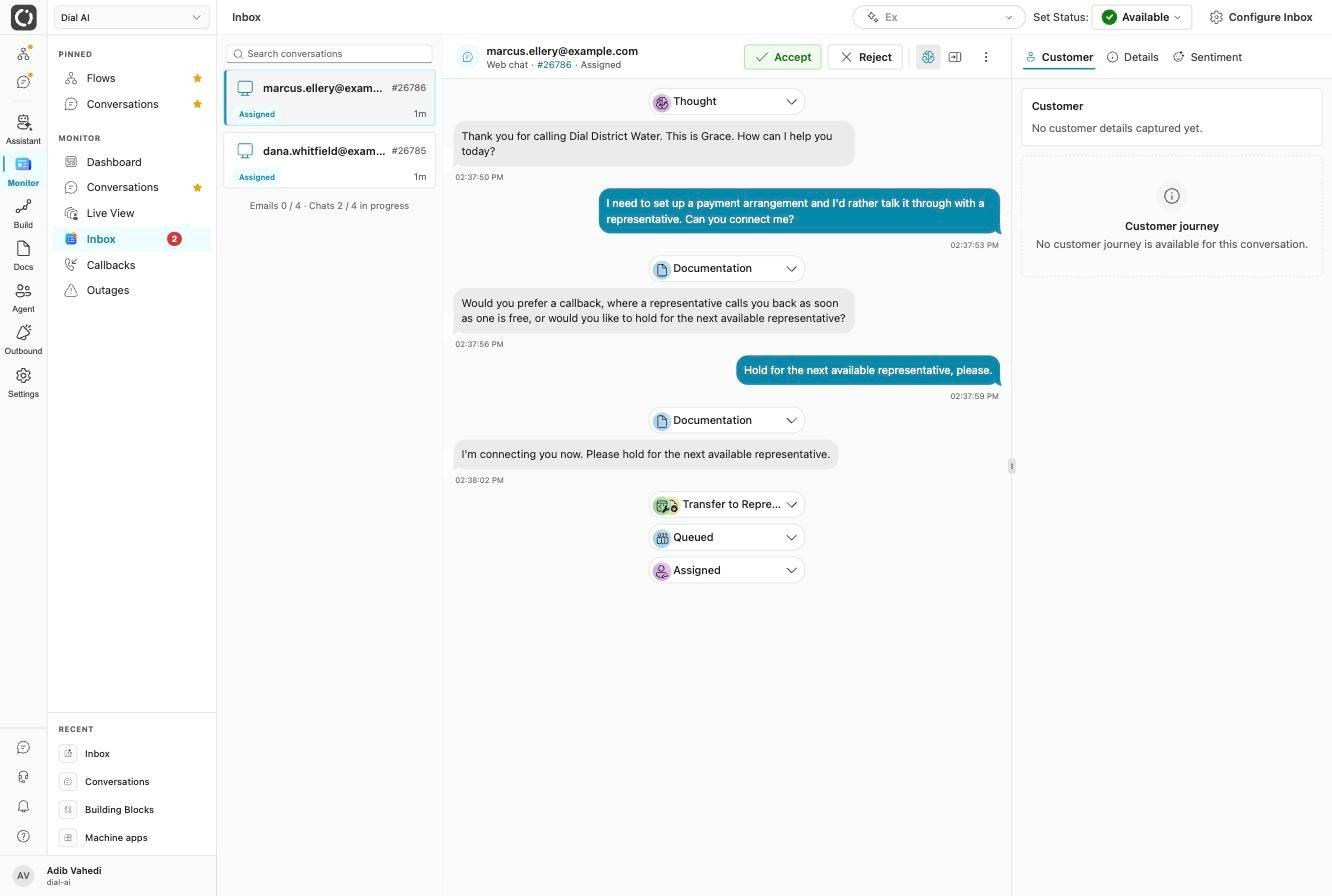
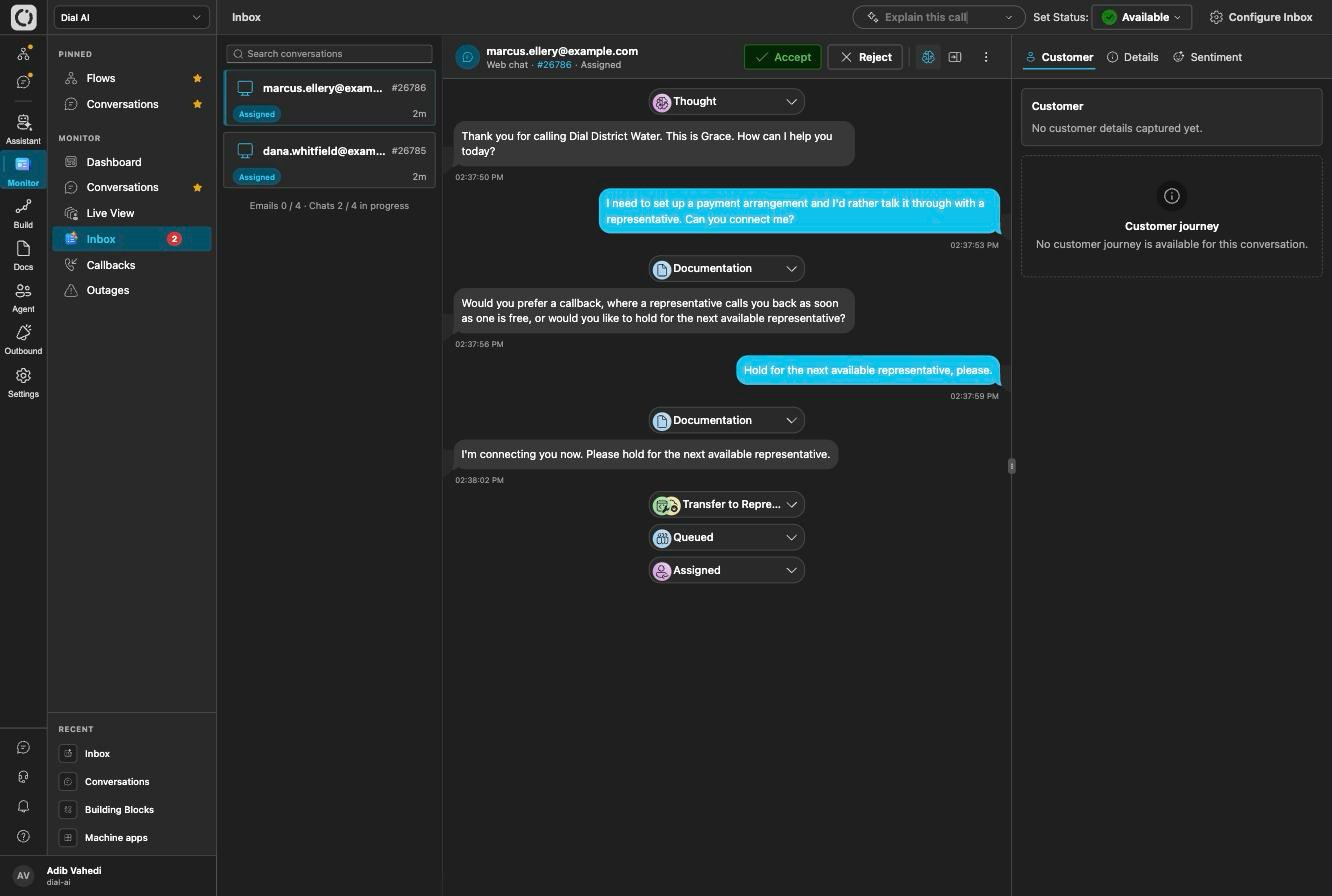
Inbox — conversations queued for human handling
Accessing the Inbox
Navigate to Monitor > Inbox in the left sidebar. There are two views:- Inbox (default) — every conversation in your queue, routed by skill match.
- Inbox / Personal — a configurable per-agent view. Set this up under Configure Inbox in the top bar.
Audio configuration (Agent Leg status)
The top-left of the Inbox shows your Agent Leg indicator — your audio connection’s readiness for voice calls.- Connected — you’re ready to receive voice calls.
- Disconnected — click to reconnect. The system uses your configured phone number from Settings > Personal Configuration, or opens a modal to set up web audio with your headset.
- Ringing — a queued voice call is being routed to you.
Status management
Use the Status dropdown in the top bar to control your availability:- Available — eligible for new conversations.
- Busy or Offline — conversations won’t route to you. Skill-based conversations that are already assigned to you are returned to the queue for reassignment; conversations that were routed directly to you (agent-specific) remain assigned and are not re-routed.
How a conversation reaches you
1
The AI queues it
The AI agent decides it needs human help — based on the flow logic, the customer’s request, or a function call — and queues the conversation with one or more Skills describing what’s needed (e.g., Billing, Spanish, Fraud Assistance). Skills are managed under Settings > Operations > Skills.
2
The ACD routes it
The Automatic Call Distributor picks an Available agent whose configured skills match. Chat and email caps can be adjusted from the Inbox top bar or under Settings > Personal Configuration. Voice calls are capped at one per agent at a time and cannot be changed.
3
You accept or reject
When a conversation is routed to you, you can Accept it to take it on, or Reject it back into the ACD for reassignment.
Taking over
- Voice calls — your phone or headset rings (per your selected audio method). Answer to take control.
- Chats / emails — open directly inside the Inbox for real-time messaging.
Ending a conversation
After you resolve the issue:- Hang up (voice) or click End (chat/email).
- The conversation enters a Wrap-up state for any final notes.
- Once wrap-up closes, you’re eligible for new conversations again.
Callbacks
When every agent is busy, the AI can offer the caller a call back instead of leaving them on hold. The caller keeps their place and hangs up, and the system rings them back the moment an agent frees up, with an estimated wait time. After hours, callers join a callbacks list your team works through the next morning.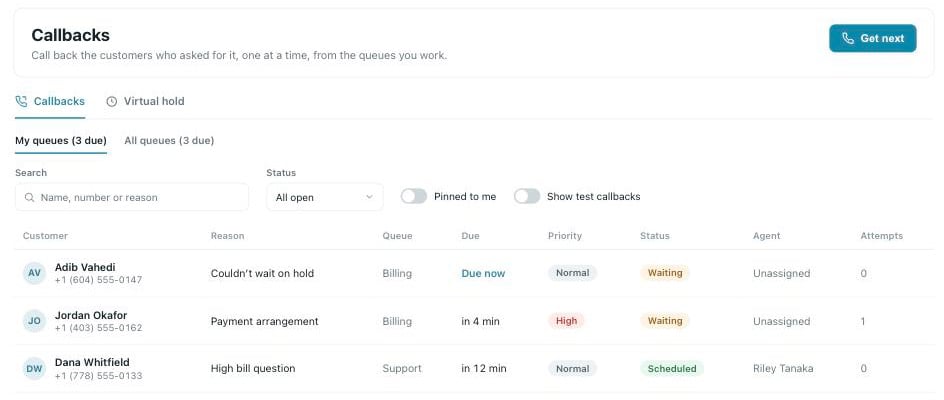
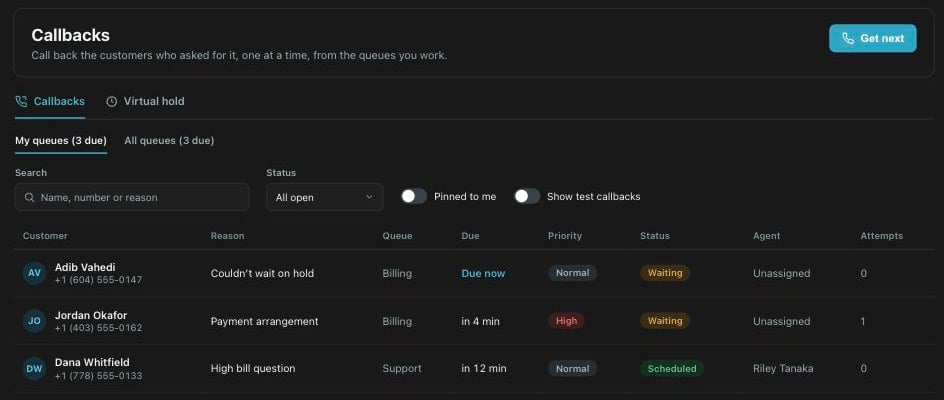
The Callbacks queue — customers who asked for a call back, worked one at a time
- Callbacks — the queue of customers waiting for a call back, with their reason, priority, and how long they have waited. Click Get next to take the top one, or pin specific queues to yourself.
- Virtual hold — a live view of callers waiting for the next free agent, whom the system calls back automatically.
Related
Live View
Watch AI-handled conversations in real time.
Conversations
Search past conversations.
Skills
Define and manage routing skills.
Personal configuration
Set your phone, status, and skill assignments.