Points of Contact

The Points of Contact page is where you manage all the communication channels through which customers can reach your AI agent. This page allows you to configure phone numbers, SMS lines, emails, web chat widgets, and Slack integrations — each linked to specific workflows, routing rules, and voice settings.

Overview

In the Points of Contact section, you can add, edit, and manage various communication channels. Each point of contact can be linked to a specific Flow (conversation workflow), configured with routing rules that control how incoming interactions are handled, and assigned a Friendly Name for easy identification.
Note: To get new phone numbers or email addresses for use with flows, please consult your account representative. Only authorized contact points can be added to the system.

Accessing Points of Contact

  1. Go to Agent > Points of Contact in the left navigation menu.
  2. The page displays available communication channels organized under Phone, SMS, Email, Web, and Slack tabs.

Channel Tabs

Each channel tab displays a table of configured points of contact with columns relevant to that channel type.

Phone

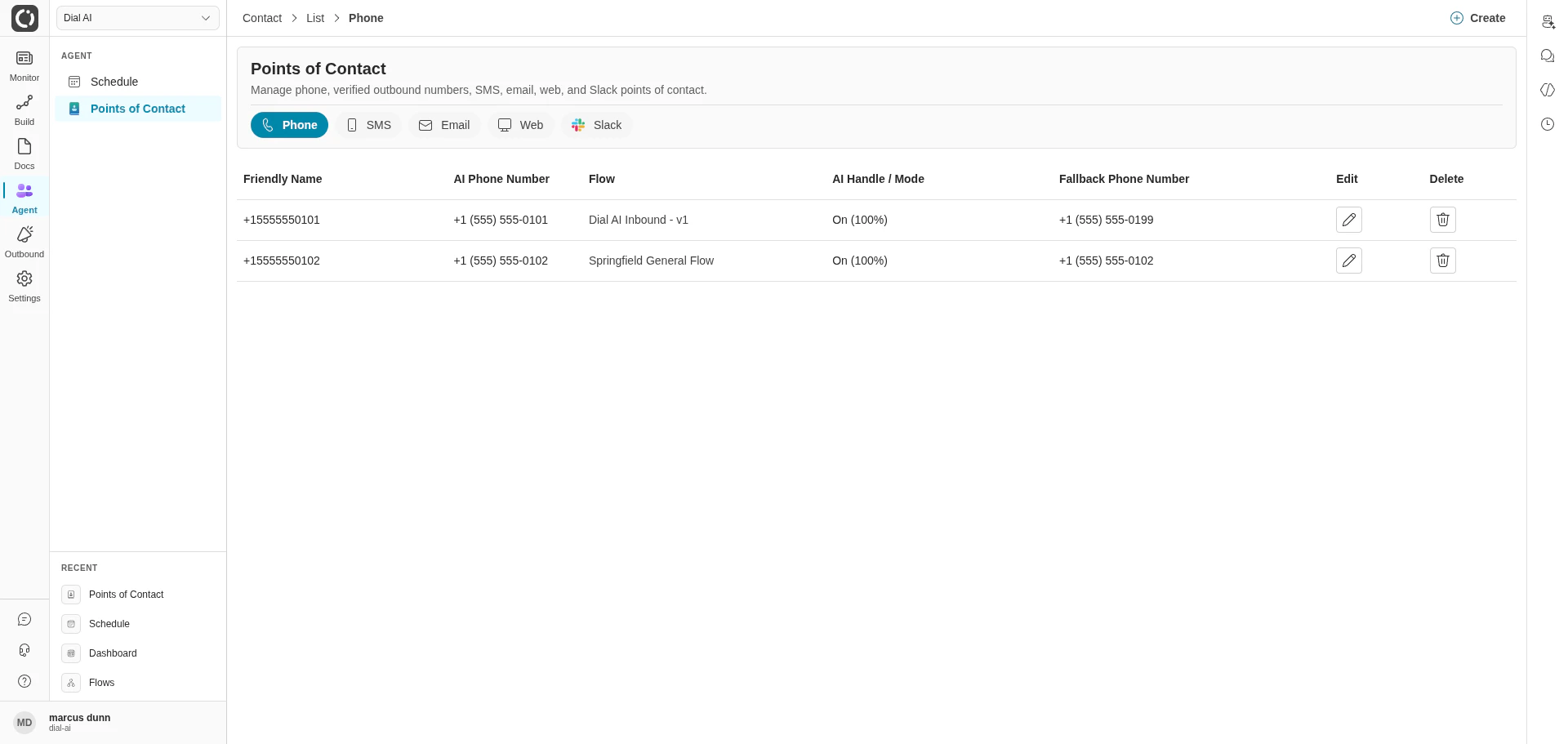
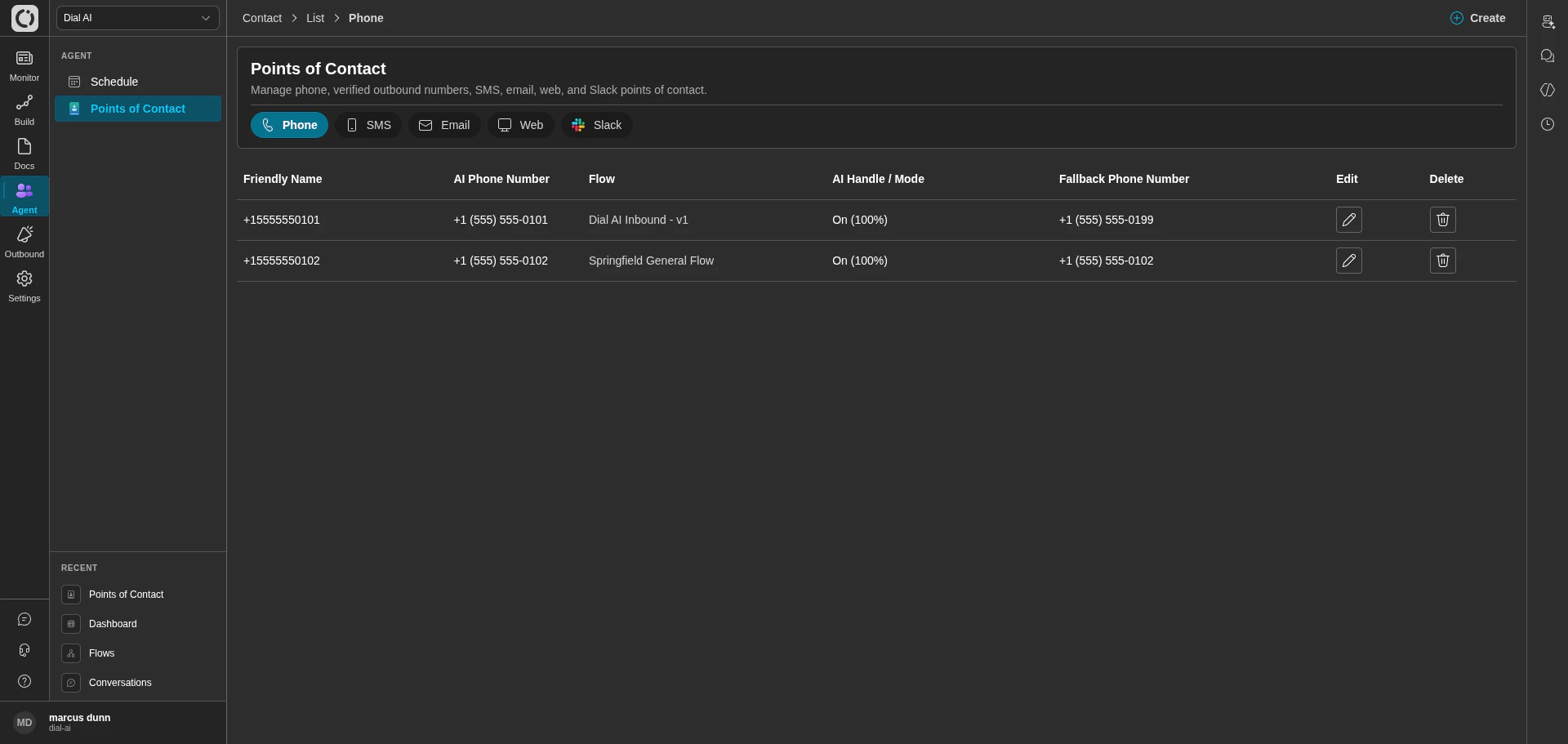
The Phone tab shows all configured phone-based points of contact with the following columns:
  • Friendly Name — A human-readable label for the phone number (e.g., “Main Support Line”).
  • AI Phone Number — The phone number assigned to the AI agent, displayed with country code formatting.
  • Flow — The conversation workflow assigned to handle calls on this number.
  • AI Handle / Mode — Shows whether the AI is active and what percentage of calls it handles (e.g., “On (100%)”).
  • Fallback Phone Number — The number calls are transferred to when the AI does not handle them.
  • Edit — Opens the configuration editor for this point of contact.
  • Delete — Removes this point of contact.

SMS

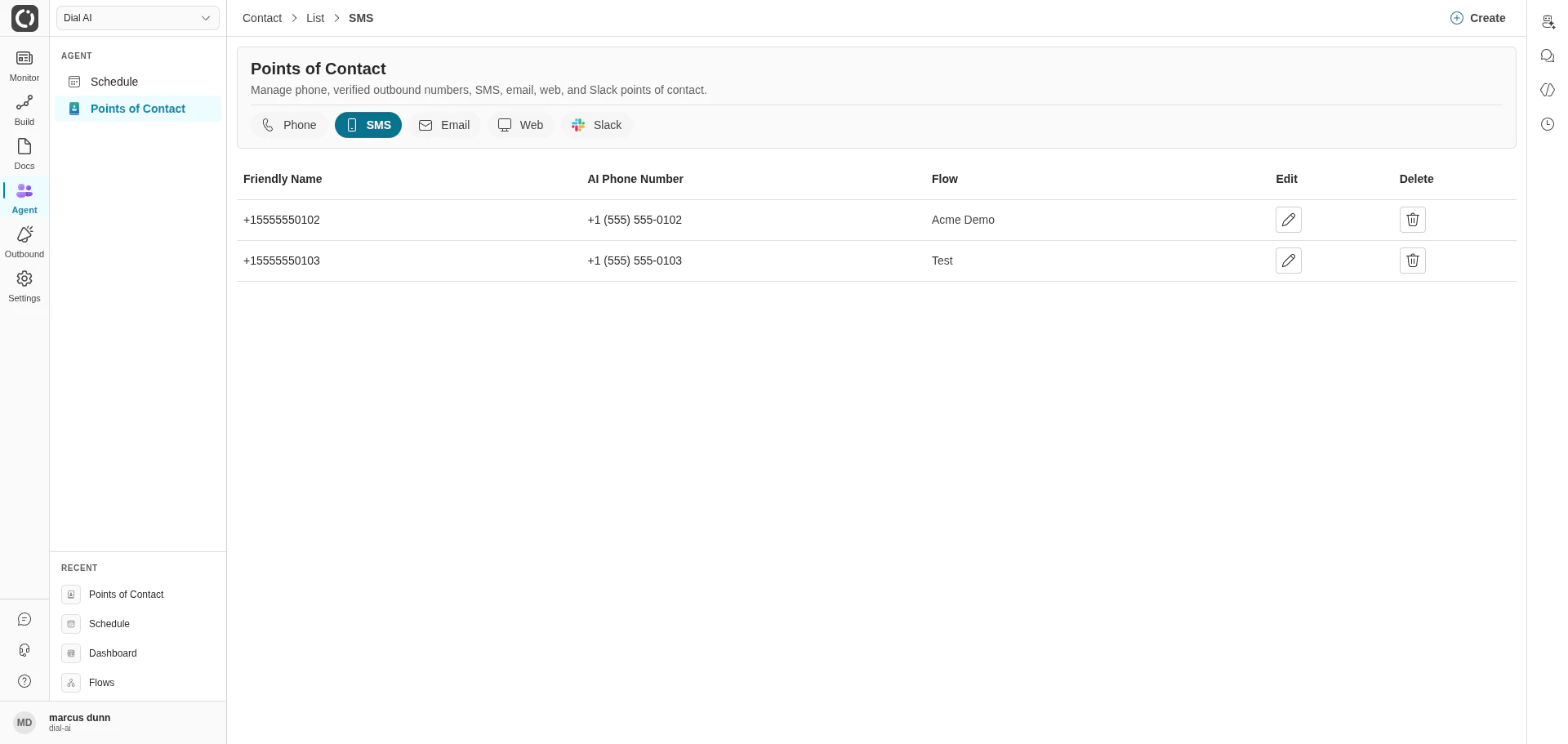
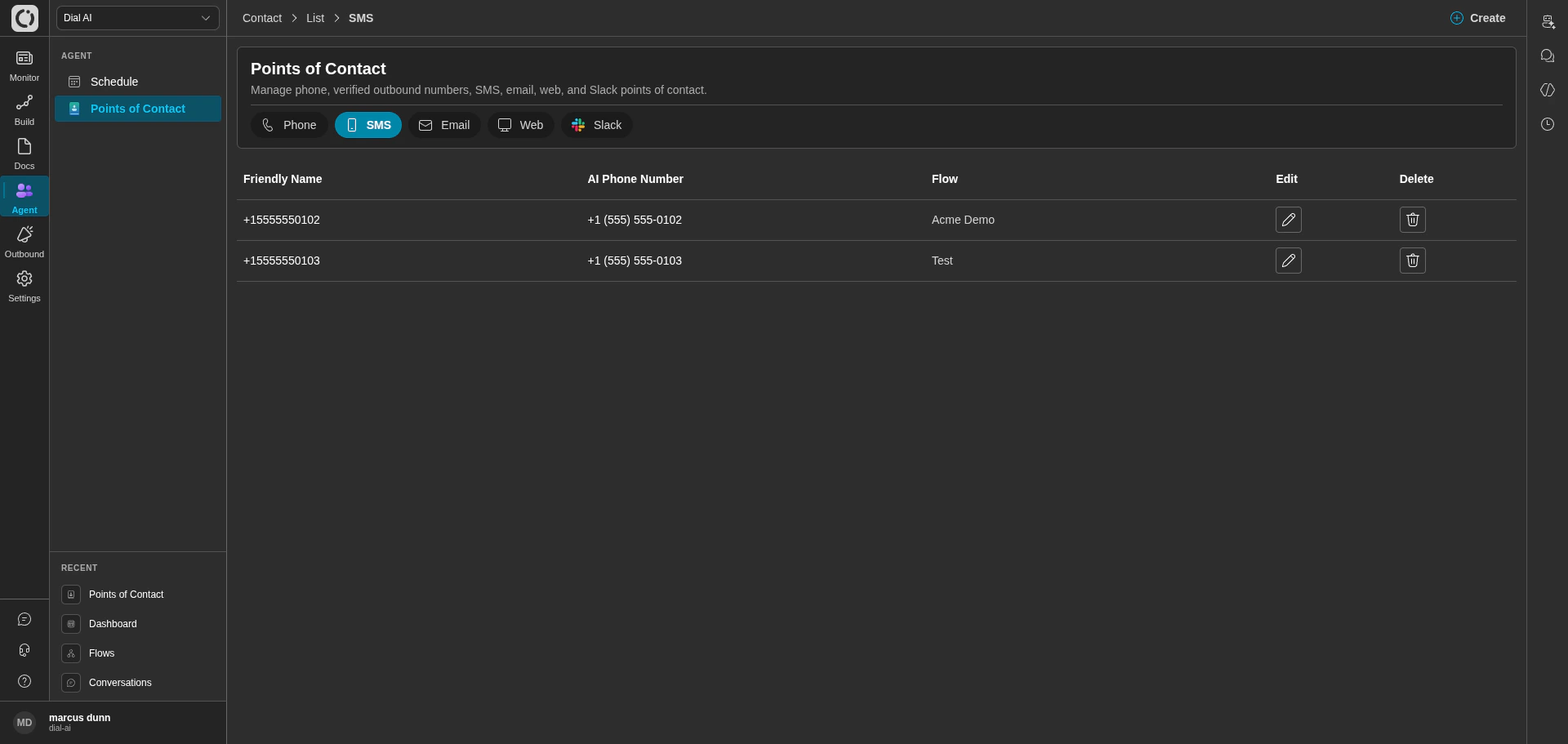
The SMS tab displays text-messaging points of contact:
  • Friendly Name — The internal label for this SMS line.
  • AI Phone Number — The phone number used for SMS conversations.
  • Flow — The conversation workflow that handles incoming messages.
  • Edit / Delete — Edit or remove the configuration.

Email

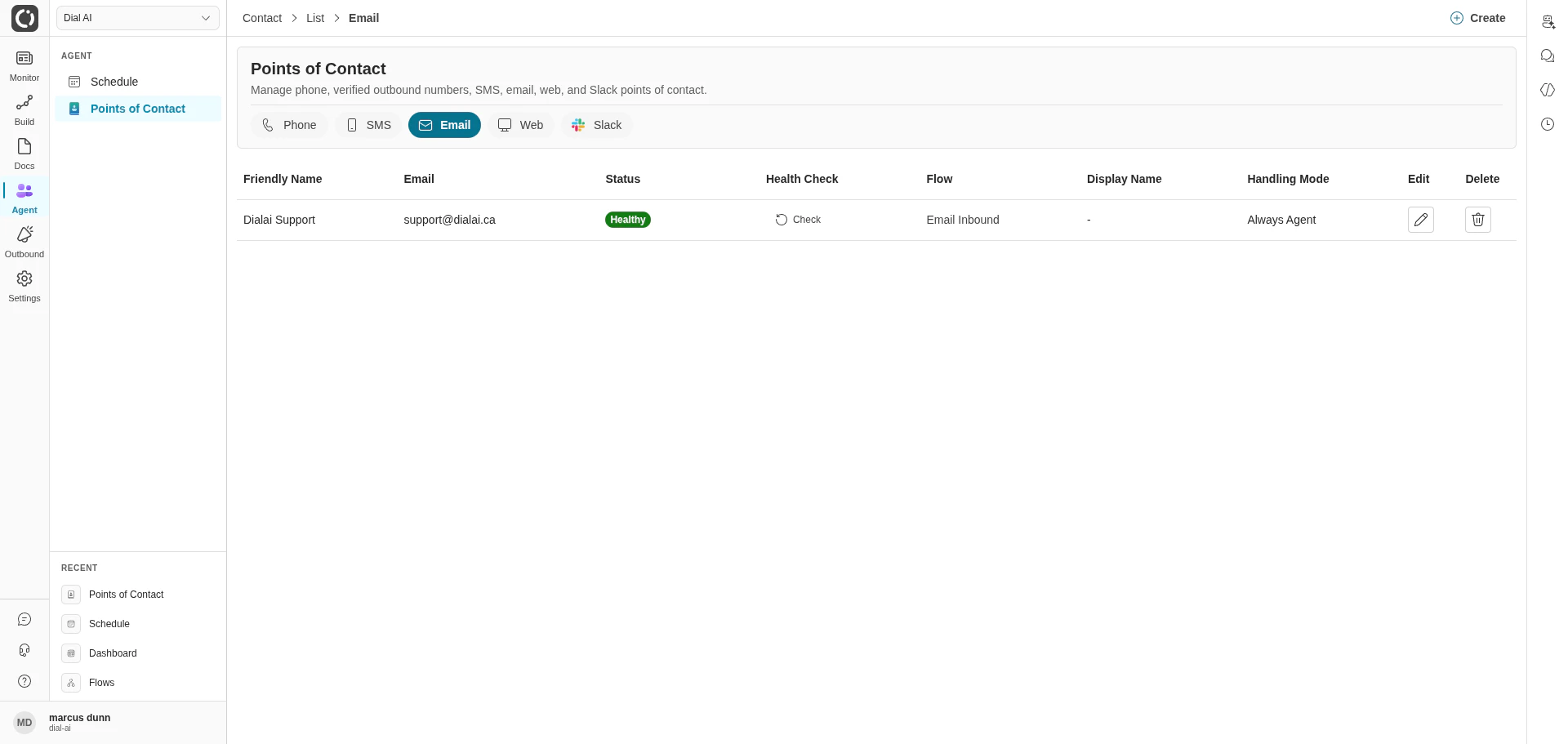
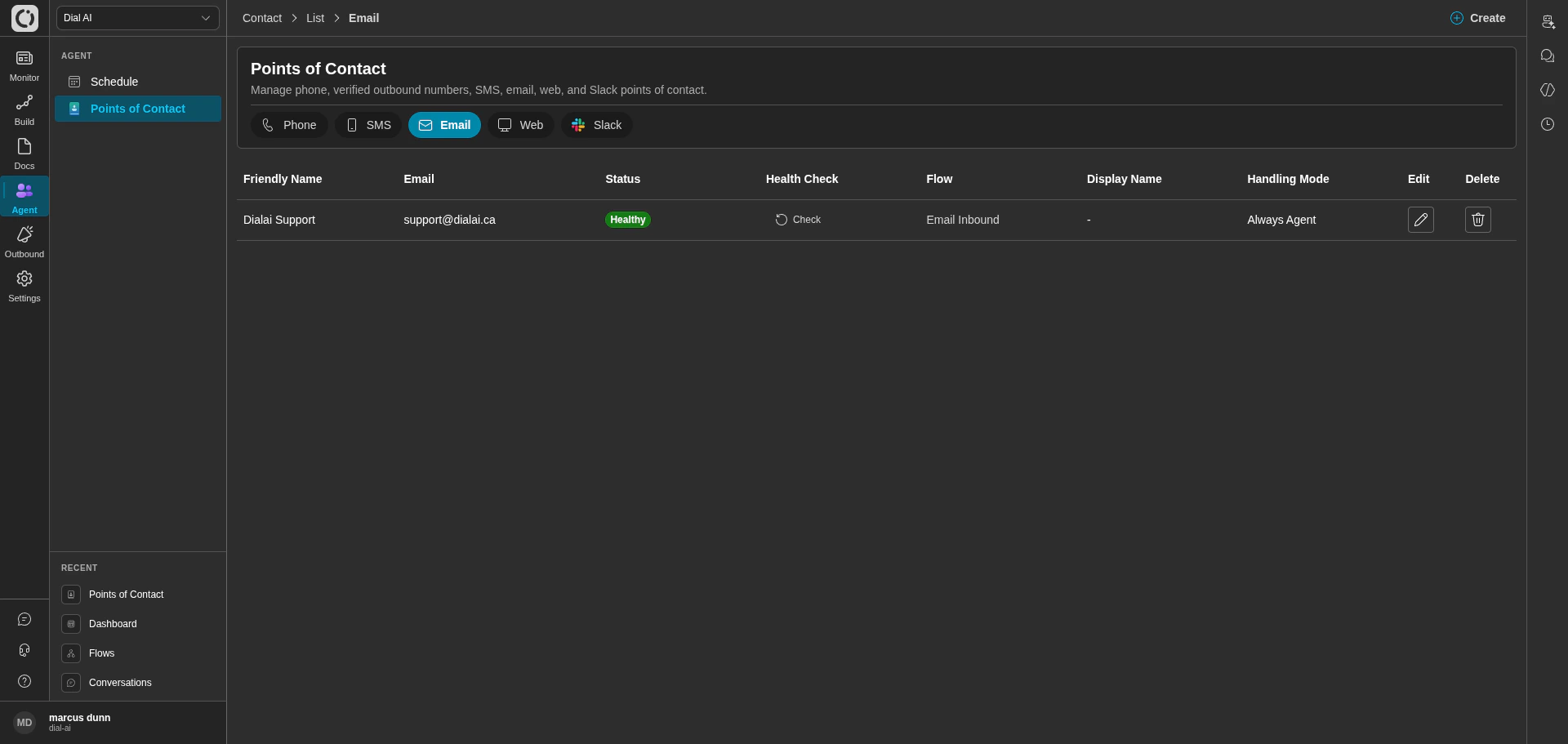
The Email tab shows email-based points of contact:
  • Friendly Name — The internal label for this email address.
  • Email — The email address used for incoming messages.
  • Status — Shows a health indicator (e.g., “Healthy” in green) for the email connection.
  • Health Check — A link to run a health check and verify the email connection is working.
  • Flow — The conversation workflow assigned to handle incoming emails.
  • Display Name — The name shown in outgoing email replies.
  • Handling Mode — How incoming emails are processed (e.g., “Always Agent”).
  • Edit — Opens the configuration editor.

Web

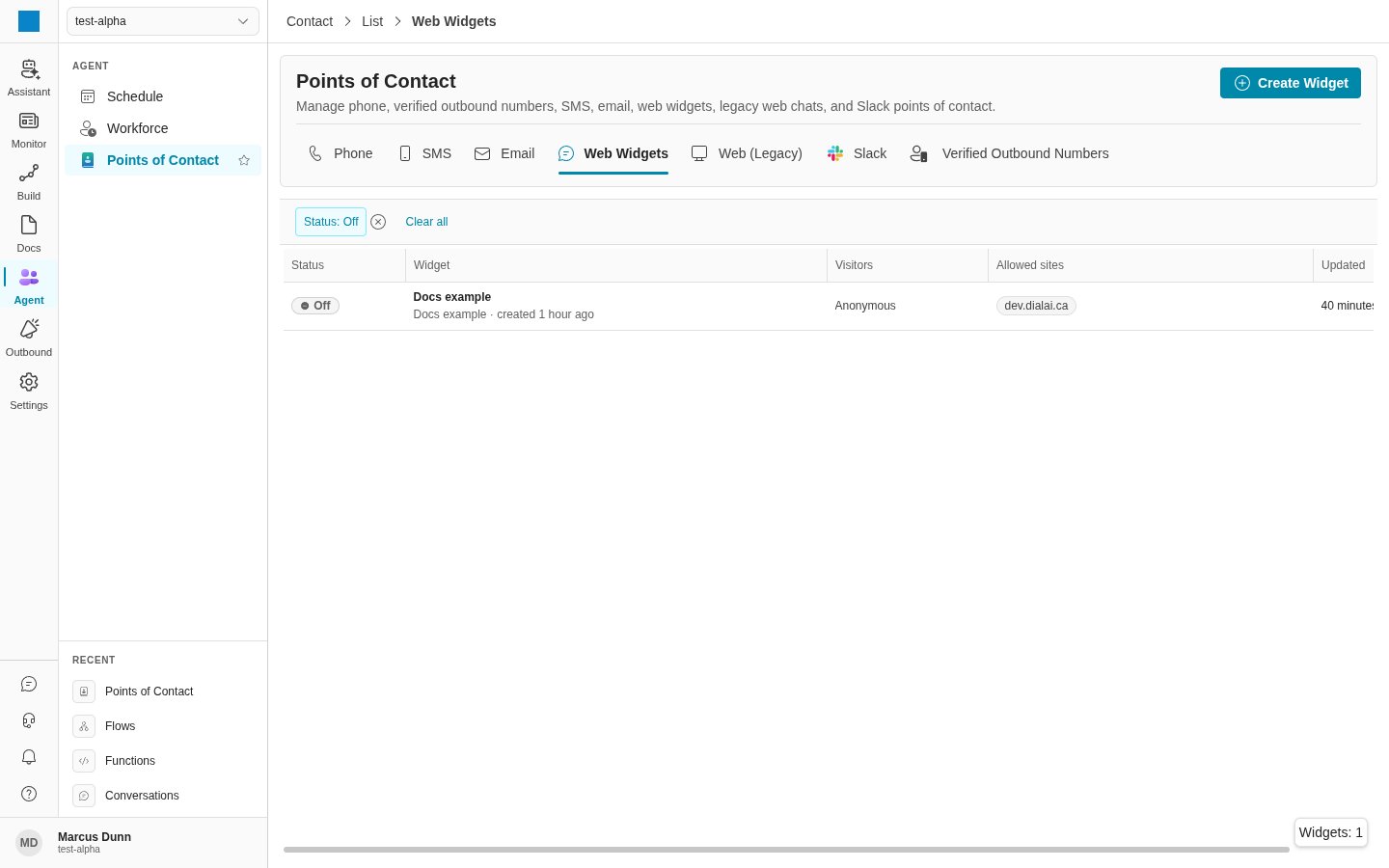
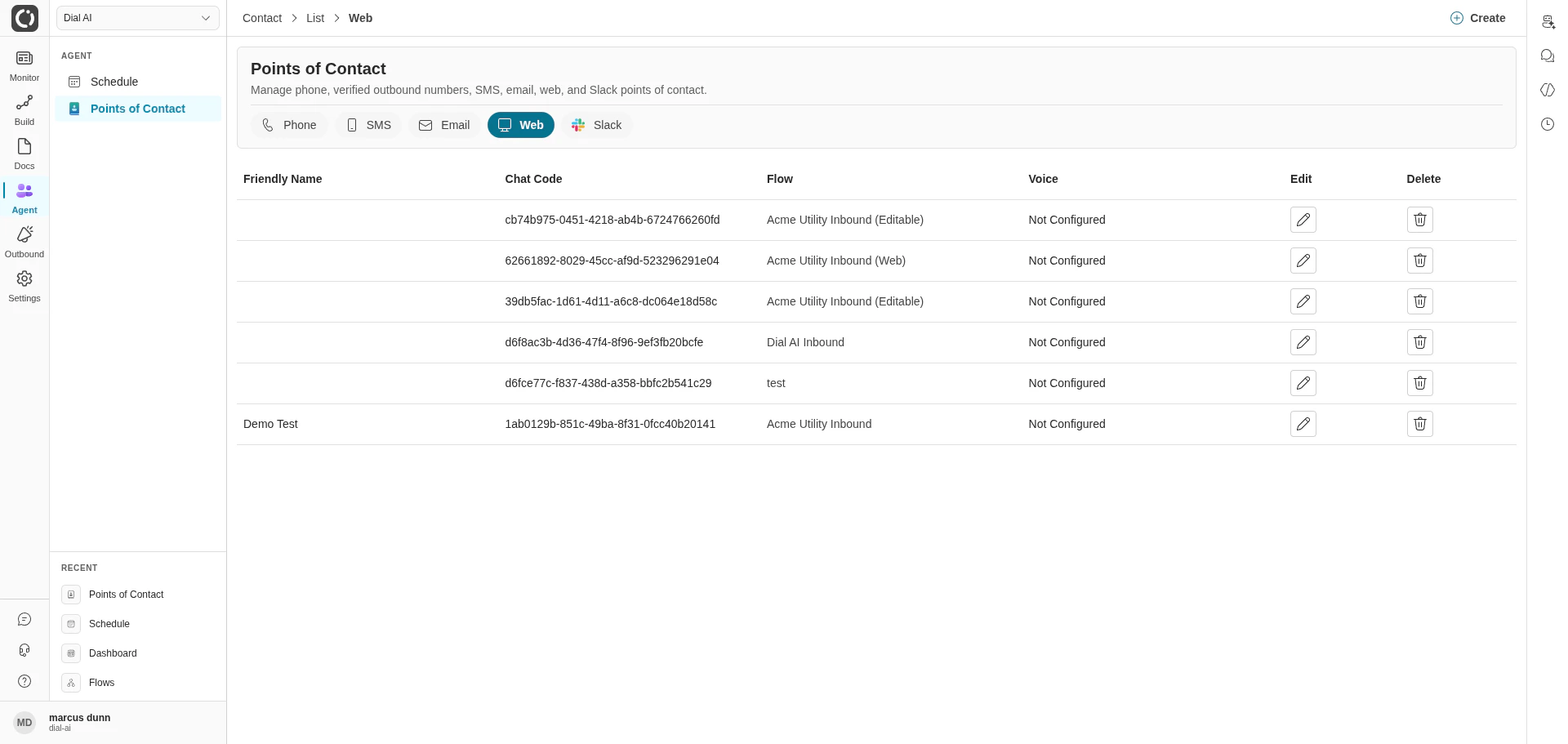
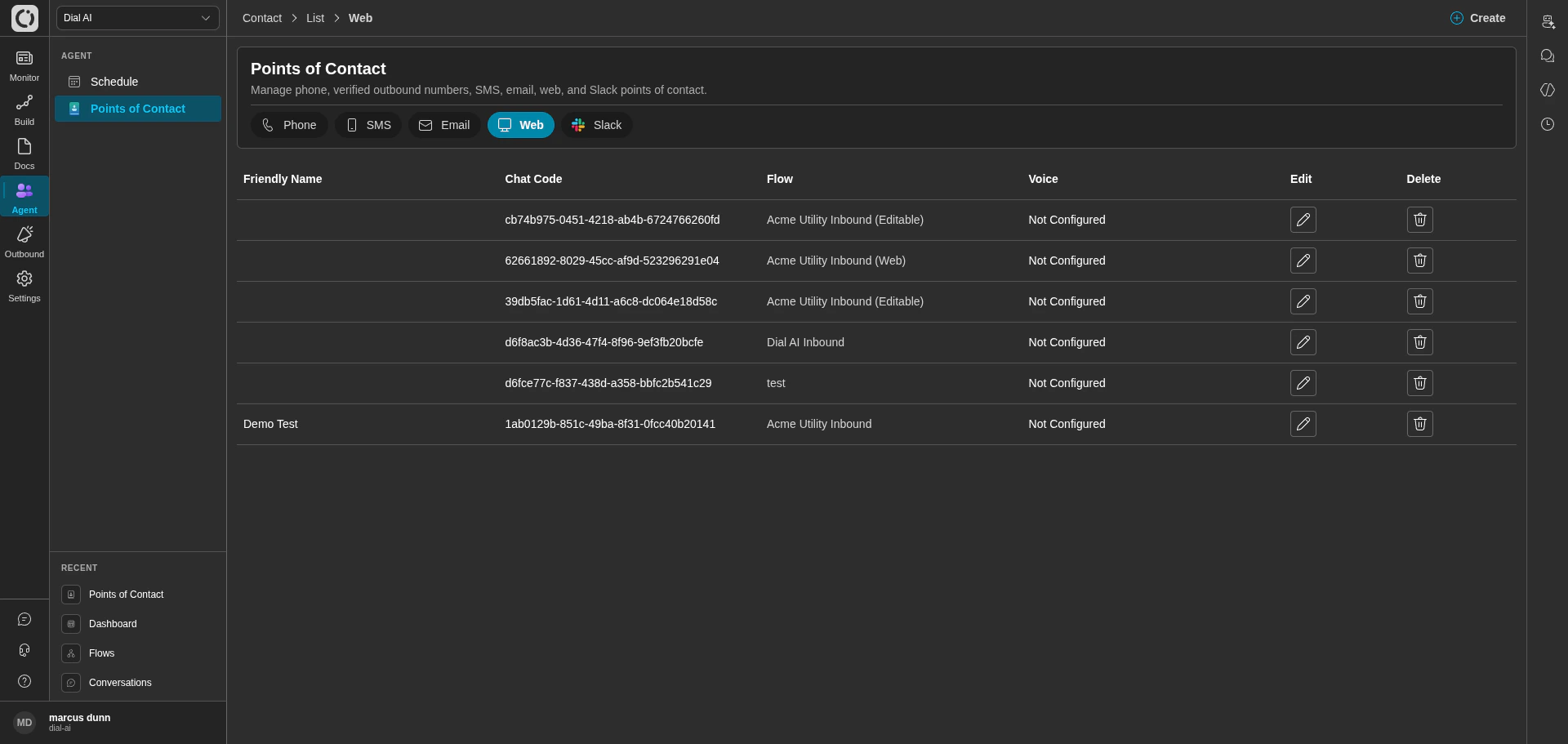
The Web tab manages web chat widget configurations:
  • Friendly Name — The internal label for this web chat.
  • Chat Code — A unique identifier (UUID) for this web chat widget, used for embedding.
  • Flow — The conversation workflow assigned to handle chat interactions.
  • Voice — The voice configuration for the web chat (if applicable).
  • Edit / Delete — Edit or remove the configuration.

Slack

The Slack tab manages Slack integrations. If no Slack configurations exist, the page displays a Create link to set one up. Use this channel to connect your AI agent directly to Slack channels.

Adding a New Point of Contact

To create a new point of contact:
  1. Navigate to Agent > Points of Contact.
  2. Click Create in the top-right corner of the page.
  3. A dialog will appear with the following fields.

Fields in the Create Point of Contact Form (Phone)

When creating a Phone point of contact, the following fields are available:
  • Channel Type — Select the channel type (Phone, SMS, Email, Web, or Slack).
  • Friendly Name — Enter an internal label for this point of contact (e.g., “Main Support Line” or “After Hours Line”). This name appears in the list view for easy identification.
  • Flow — Choose the conversation workflow that handles interactions on this channel.
  • Phone Number — Enter the registered phone number. Use the country flag dropdown to select the correct country code.
  • Environment — Choose whether this point of contact is for Production use or Internal Testing.
  • Speech to Text Runner — Select the speech-to-text provider (e.g., “deepgram”).
  • Speech to Text Model — Select the specific model from the chosen provider (e.g., “nova-3”).
  • Speech to Text Endpointing — Set the silence threshold in milliseconds before the system considers the caller has finished speaking (default: 200).
  • Voice — Choose the AI voice for this point of contact.
  • Background Noise — Enable or disable ambient call center sounds during the phone call.
Click Create to save the new point of contact.
Tip: The fields shown in the Create dialog vary by channel type. For example, SMS points of contact do not include Voice or Speech to Text settings.

Editing Points of Contact

To modify an existing point of contact:
  1. Click the Edit icon (pencil) next to the point of contact you wish to change.
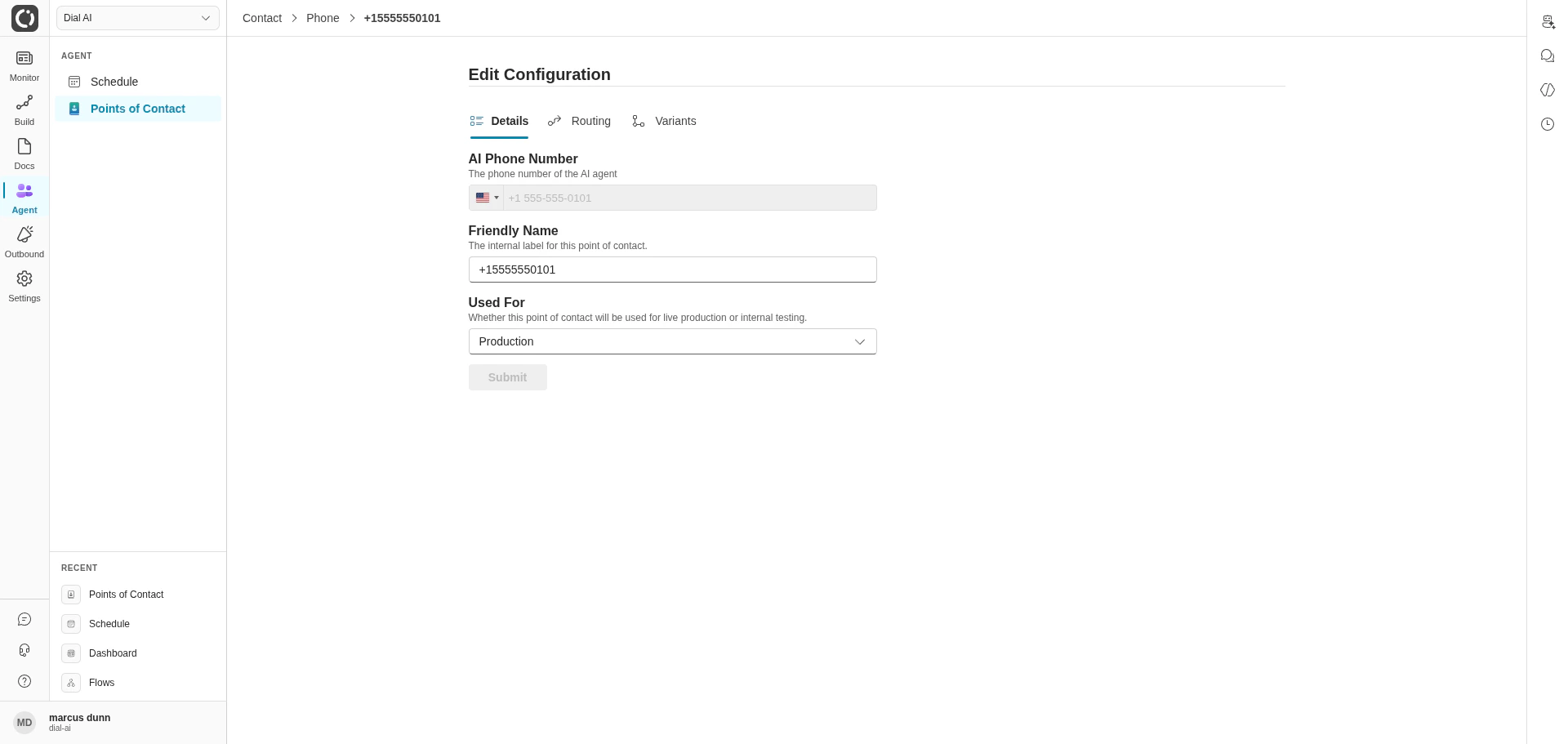
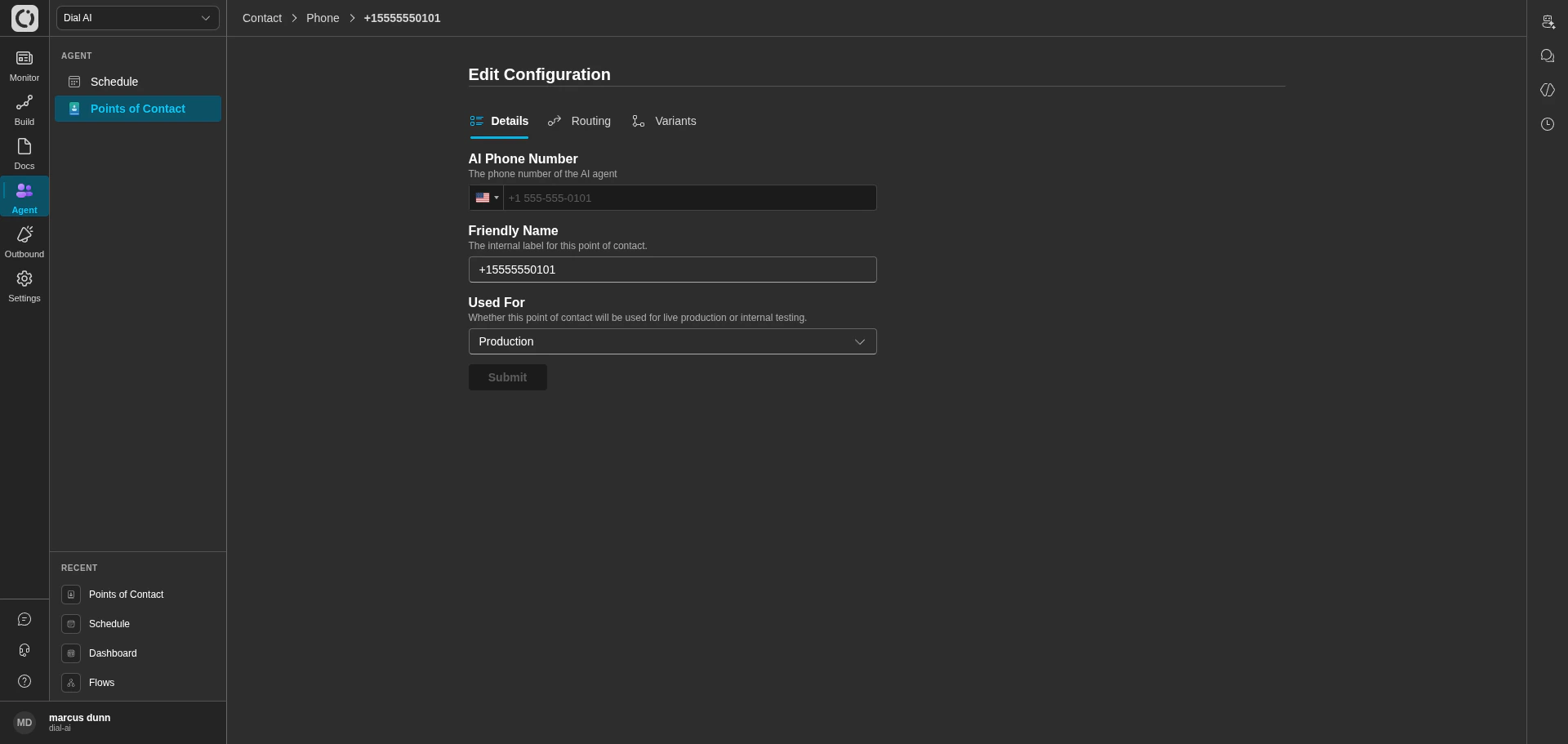
  2. The Edit Configuration page opens with three tabs: Details, Routing, and Variants.

Details Tab

The Details tab contains the basic identifying information for the point of contact:
  • AI Phone Number — The phone number of the AI agent (read-only, displayed with country flag).
  • Friendly Name — The internal label for this point of contact. Update this to a descriptive name like “Main Support Line” or “Sales Inquiries”.
  • Used For — Select whether this point of contact is used for Production or internal testing.
Click Submit to save changes.

Routing Tab

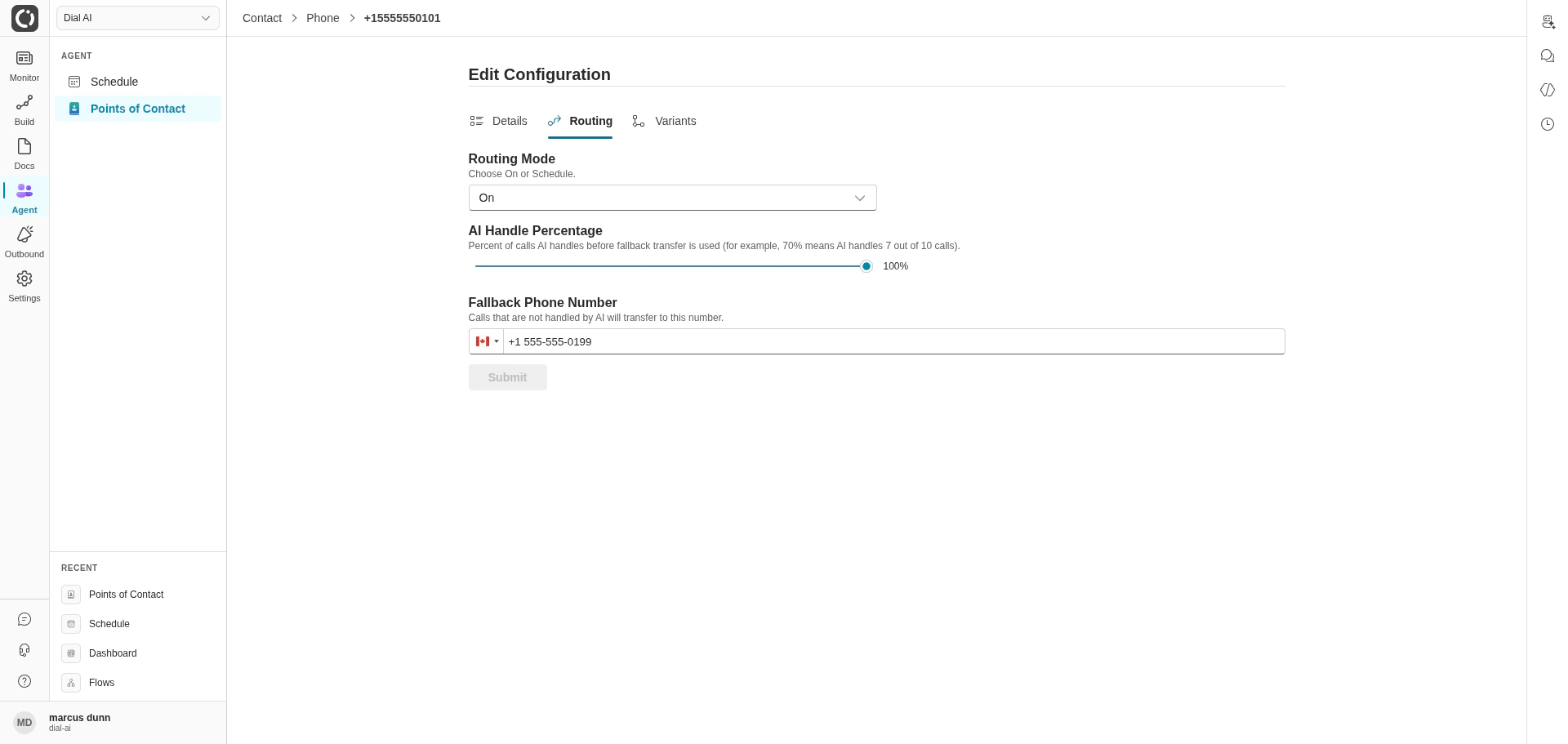
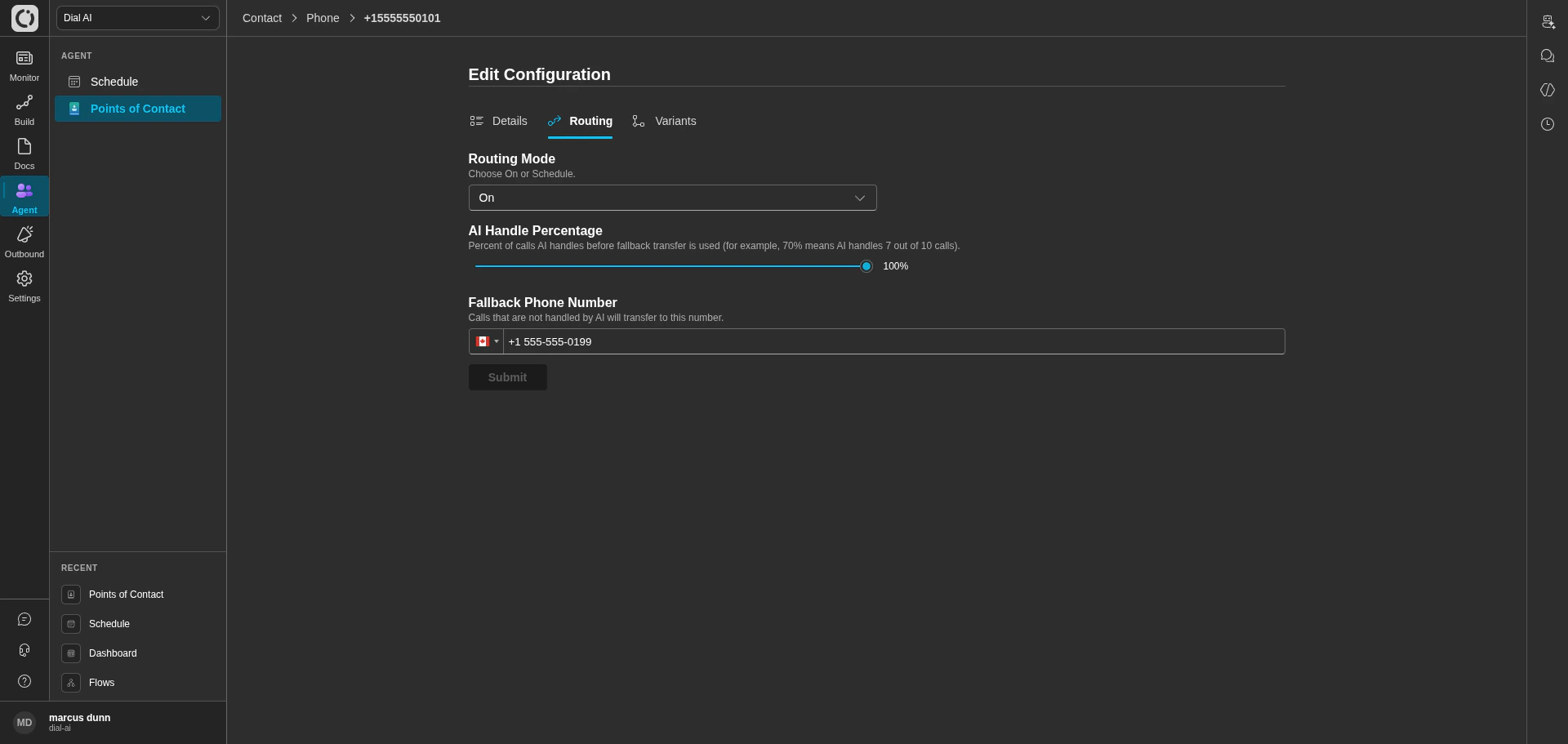
The Routing tab controls how incoming calls are distributed between the AI agent and human operators.

Routing Mode

Choose between two routing modes:
  • On — The AI agent is always active. When selected, you can configure:
    • AI Handle Percentage — A slider (0–100%) controlling what portion of calls the AI handles. For example, 70% means the AI handles 7 out of 10 calls, while the remaining 3 are transferred to the fallback number. This is useful for gradually rolling out the AI agent.
    • Fallback Phone Number — The phone number where calls not handled by the AI are transferred.
  • Schedule — The AI agent is active only during configured time windows. When selected, you’ll see:
    • Schedule — Shows any configured schedules or “No schedules yet.” Click the Edit Schedule button to open the schedule editor (see Setting Up Schedules below).
    • Fallback Phone Number — Calls outside scheduled windows transfer to this number.
Click Submit to save routing changes.

Variants Tab

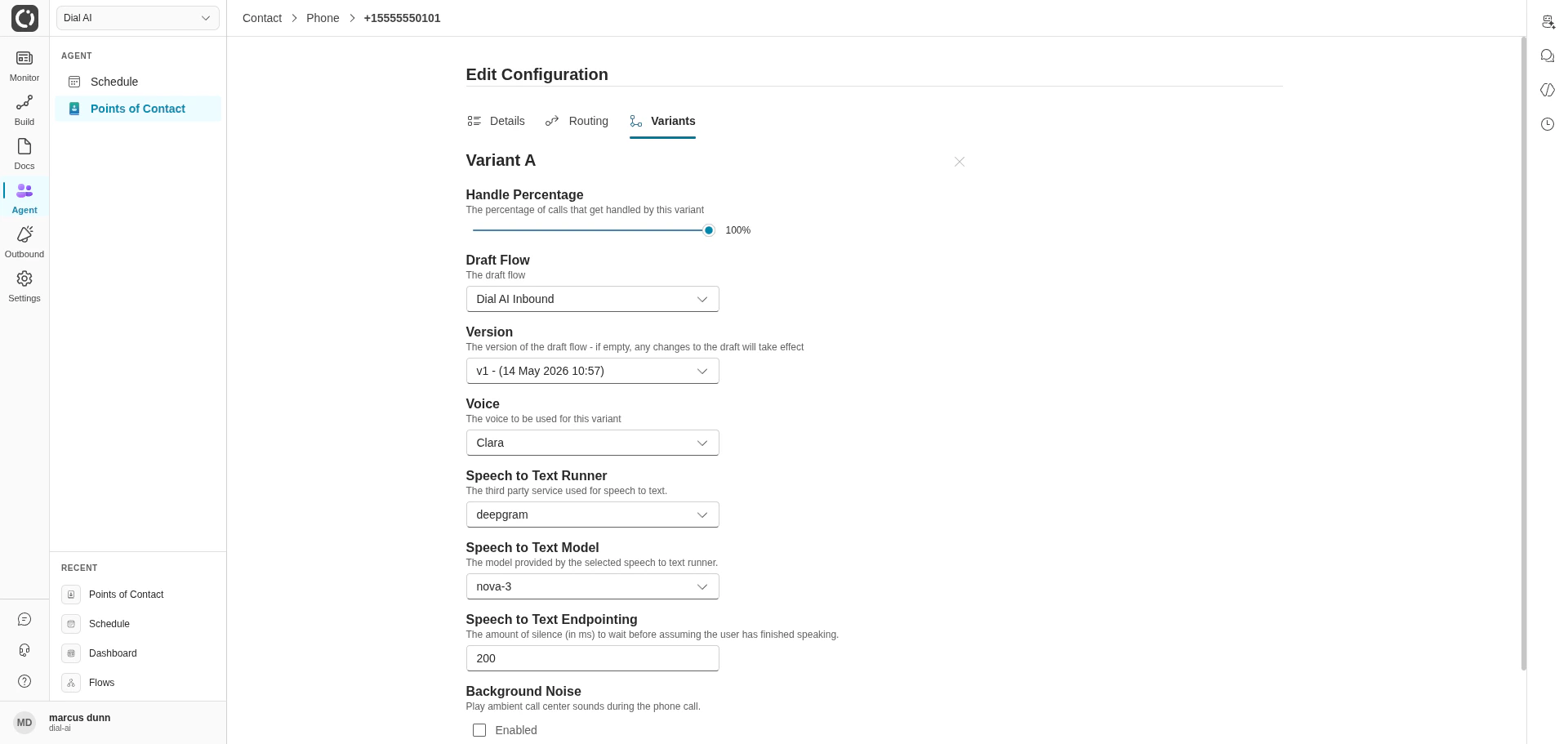
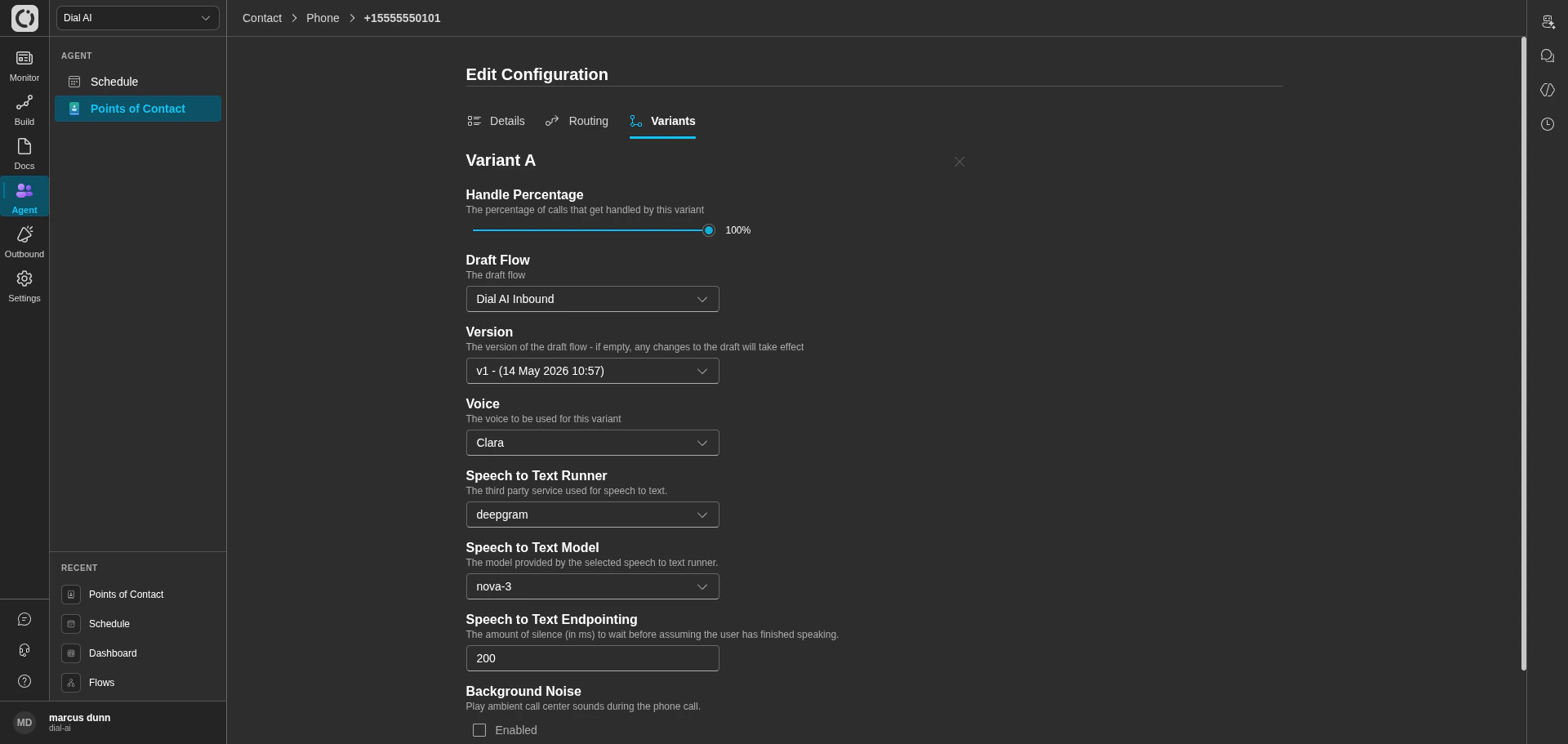
The Variants tab allows you to configure one or more flow variants for A/B testing different conversation workflows, voices, and settings. Each variant includes:
  • Handle Percentage — The percentage of calls routed to this variant. When using multiple variants, percentages should add up to 100%.
  • Draft Flow — The conversation workflow for this variant.
  • Version — The published version of the flow to deploy. If left empty, any changes made to the draft flow take effect automatically.
  • Voice — The AI voice used for this variant (e.g., “Clara”).
  • Speech to Text Runner — The speech-to-text provider (e.g., “deepgram”).
  • Speech to Text Model — The specific model from the provider (e.g., “nova-3”).
  • Speech to Text Endpointing — Silence threshold in milliseconds before the system considers the user has finished speaking.
  • Background Noise — Toggle ambient call center sounds during the call.
Click Add variant to create additional variants for testing. Click the × next to a variant name to remove it. Click Submit to save variant changes.

Setting Up Schedules

Schedules allow you to define time windows when the AI agent is active for a specific point of contact. Outside of these windows, AI handle is set to 0% and all calls transfer to the fallback number.

Accessing the Schedule Editor

There are two ways to access the schedule editor:
  1. From a Point of Contact: Edit a point of contact > Routing tab > set Routing Mode to Schedule > click Edit Schedule.
  2. From the Schedule Page: Navigate to Agent > Schedule in the left navigation menu to see a combined calendar view of all phone number schedules.

Creating a Schedule

  1. In the schedule editor, click + New Event (or drag on the calendar to prefill the time window).
  2. The Add Schedule dialog appears with these fields:
    • Name — A label for this schedule window (e.g., “Business Hours” or “Weekend Support”).
    • AI Handle Percentage — The percentage of calls handled by the AI during this window (0–100%).
    • Time Window:
      • From — Select the start day and time (e.g., Monday at 09:00).
      • To — Select the end day and time (e.g., Friday at 17:00).
    • Enabled — Check Active to enable this schedule. Uncheck to disable without deleting.
  3. Click Add to save the schedule.

Schedule Rules

  • Each schedule row repeats weekly.
  • Outside active windows, AI handle is 0% and calls transfer to the fallback number.
  • Same-day windows require the end time to be after the start time.
  • Overlapping windows for the same phone number are not allowed.
  • You can edit existing windows from the schedule list on the right side of the calendar.

Schedule Examples

  • Weekday business hours: Monday 9:00 AM to Friday 5:00 PM.
  • After-hours coverage: Saturday 5:00 PM to Monday 8:00 AM.
  • Night shift: Monday 8:00 PM to Tuesday 5:00 AM.

Calendar Views

The schedule editor supports four calendar views:
  • Month — Overview of the entire month.
  • Week — Detailed view of a single week with hourly time slots.
  • Day — Focused view of a single day.
  • Agenda — List-based view of upcoming scheduled windows.
Use the Today, Back, and Next buttons to navigate between time periods.

The Schedule Page

The Schedule page (accessed via Agent > Schedule) provides a combined view of all phone number schedules in one place.

Layout

  • Left Panel — Filters: Toggle visibility of phone numbers using checkboxes. Each number shows its current status (e.g., “ON · 100% AI handle”).
  • Center — Calendar: Displays colored bars for each phone number showing their active windows and AI handle percentage.
  • Right Panel — Schedules: Shows the total and active schedule count for the selected phone numbers.
This page is useful for getting a bird’s-eye view of when your AI agents are active across all phone numbers.

Summary

The Points of Contact page allows you to manage the various ways customers reach your AI system. Key capabilities include:
  • Friendly Names for easy identification of each channel.
  • Routing controls to manage AI vs. human call distribution with percentage-based handling.
  • Schedule-based routing to define business hours and after-hours behavior.
  • A/B testing through flow variants with configurable weights, voices, and speech-to-text settings.
  • Multiple channel types including Phone, SMS, Email, Web, and Slack.
For any new phone numbers or email addresses, please coordinate with your account representative to ensure all channels are authorized for use.